Artificial intelligence is fundamentally changing how companies approach software development. Applications that once required significant technical resources and months of work can now be prototyped in days, sometimes by employees with limited traditional programming experience. AI-powered tools can generate code, connect data sources, automate repetitive tasks, and create AI agents capable of performing increasingly complex business processes. For industrial organizations, these capabilities are opening doors to opportunities that may have previously been considered too expensive or time-consuming to pursue.
Naturally, this shift is raising an important question: If we can build software and AI agents ourselves, why should we invest in an outside technology partner?
It's a fair question, and in many situations, building internally may be the right decision. But there's an important distinction between having the ability to create software and having the resources, processes, and expertise to deploy and operate it successfully over time. While AI has dramatically reduced some of the technical barriers to development, it hasn't eliminated the complexity of the business problems that technology is intended to solve.
For refinery operators and industrial service providers, the decision to build or buy a software or AI solution should ultimately come down to more than development costs. It should consider operational complexity, internal resources, implementation timelines, long-term ownership, and the ability to deliver measurable business value.
The Difference Between a Working Prototype and a Production-Ready Solution
One of the most exciting developments in AI-assisted software development is how quickly an idea can become something tangible. An employee identifies an inefficient process, describes the desired functionality to an AI development tool, and produces a working application. Information begins flowing between systems, repetitive tasks disappear, and a process that previously consumed hours of administrative work suddenly looks much easier to manage. The demonstration is impressive, and the possibilities seem endless.
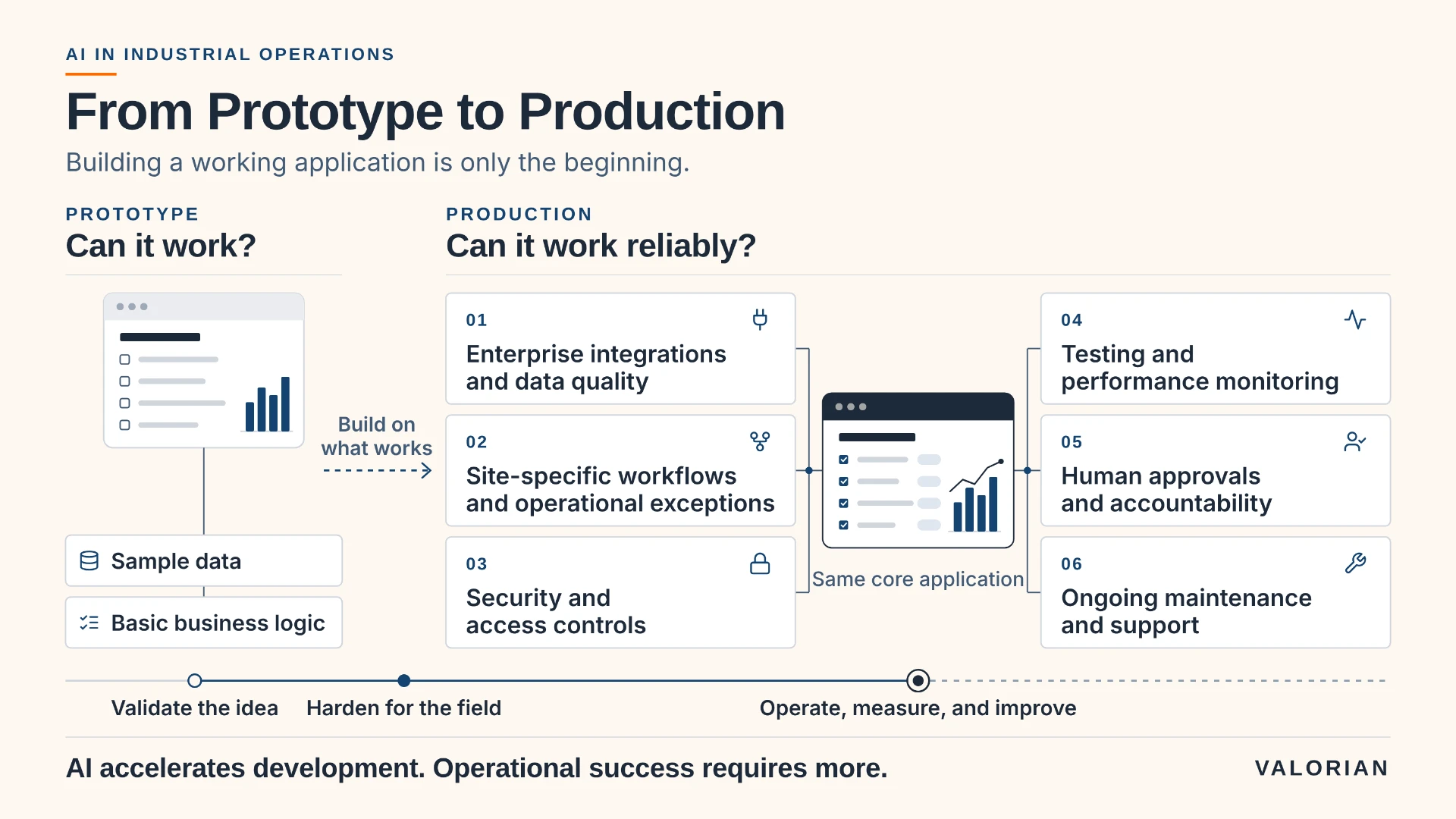
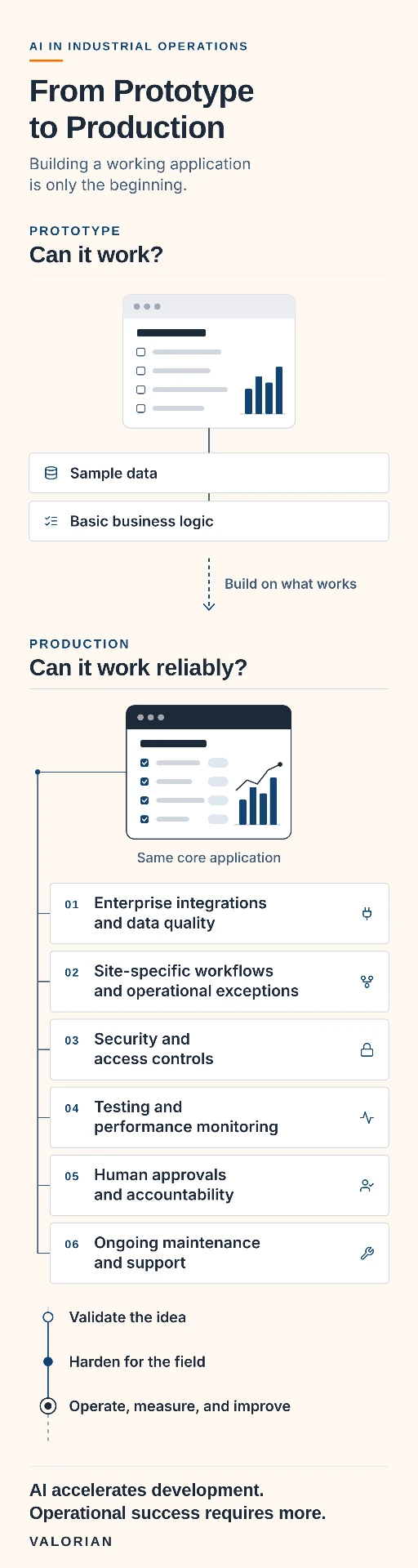
That early success is valuable. It allows organizations to test ideas, validate opportunities, and explore solutions without committing the resources traditionally associated with custom software development. However, a successful demonstration answers only one question: Can we make this work under the conditions we've tested?
Moving from a prototype to a dependable operational solution introduces an entirely different set of requirements. Production software must accommodate incomplete or inconsistent information, changing business processes, multiple user roles, system outages, and situations that weren't anticipated during development. It must also integrate with existing technology, protect sensitive information, and continue functioning reliably as the organization evolves. These responsibilities don't disappear simply because the initial application was easier to build.
Google's 2025 DORA research reinforces this distinction, finding that AI's impact on software development depends heavily on the strength of an organization's underlying processes and technical practices. Faster development can improve productivity, but it doesn't automatically produce more reliable software or better business outcomes.
For industrial organizations, where technology may support maintenance activities, workforce coordination, compliance processes, and other essential operations, the ability to function reliably under real-world conditions is often more important than how quickly the first version was created.
Why Industrial Operations Require More Than Functional Software
Industrial organizations operate within environments that rarely follow one perfectly standardized workflow. Refinery owners, plant operators, and industrial contractors depend on interconnected processes involving employees, equipment, work orders, schedules, safety requirements, and multiple layers of approval. Information often moves between enterprise resource planning (ERP) systems, maintenance management platforms, scheduling tools, contractor management applications, and spreadsheets. While each system may perform its intended function, coordinating the information between them can create significant administrative complexity.
Consider the process of preparing and coordinating maintenance work at an industrial facility. At first glance, an AI agent designed to support work readiness might appear relatively straightforward to build. It could retrieve work orders, review schedules, identify missing documentation, and notify the appropriate personnel when something requires attention. An initial prototype might demonstrate these capabilities successfully with a limited set of data and a relatively simple workflow.
But the actual process involves far more complexity. Work priorities change, schedules shift, equipment becomes unavailable, and different jobs may require specific qualifications, permits, safety procedures, or approvals. Information may be incomplete or inconsistent across systems, and the responsibilities of the facility owner and the contractors performing the work aren't always the same. An owner-operator may need visibility into equipment readiness, maintenance priorities, and site authorization requirements, while a contractor may be focused on workforce availability, required documentation, and ensuring personnel and resources are prepared to execute the assigned scope.
An effective solution must understand how those activities connect, recognize when information is missing or conflicting, and determine when an issue requires additional review. It must also support established safety procedures and authorization processes rather than attempting to replace them. The technology needs to accommodate how work actually happens, including the exceptions and changes that occur throughout normal operations.
This is where industry-specific expertise becomes particularly valuable. Building an application that retrieves information or performs an individual task may be relatively simple. Designing a solution that understands the relationships between operational activities, applies the appropriate business rules, and supports different stakeholders requires a deeper understanding of the work itself.
In industrial environments, much of the value comes from managing the complexity surrounding a process, not simply automating its most straightforward steps.
The True Cost of Building Software and AI Agents Internally
AI has changed the economics of software development, particularly by reducing the time required for certain coding, testing, and documentation tasks. It's understandable that organizations are reconsidering whether applications that previously required outside developers can now be built more economically using internal resources. However, comparing the cost of an AI development tool with the price of an external software project doesn't provide an accurate picture of the total investment.
The total cost of ownership extends well beyond writing the initial code. Before deployment, someone must define the requirements, understand the workflows, prepare the data, develop integrations, establish appropriate security controls, validate the solution, and train employees. Once the application is operational, resources are needed to monitor performance, address defects, manage updates, support users, and adapt to changing business requirements. AI agents introduce additional considerations, including model usage costs, ongoing performance evaluations, and managing changes in AI behavior.
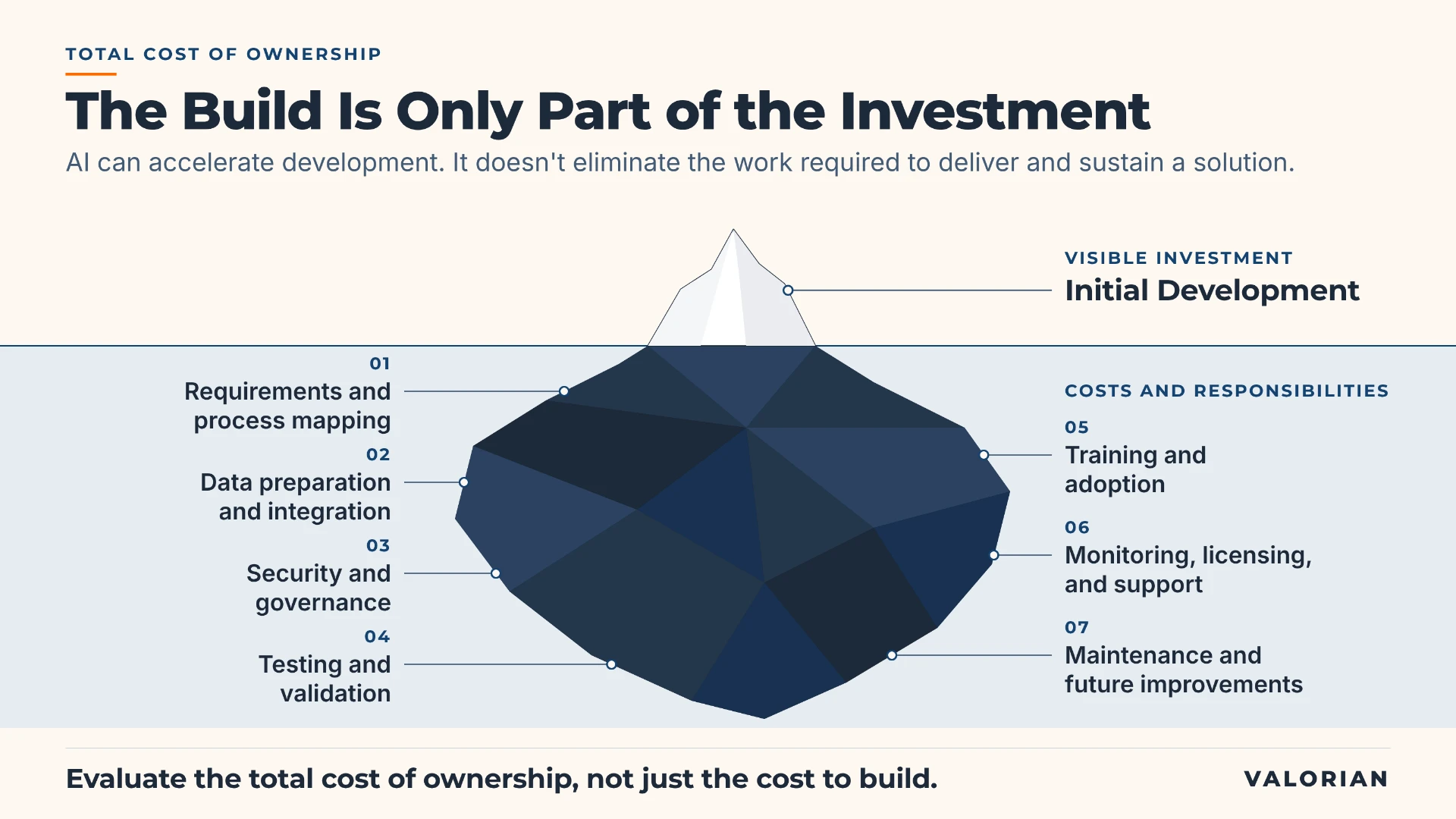
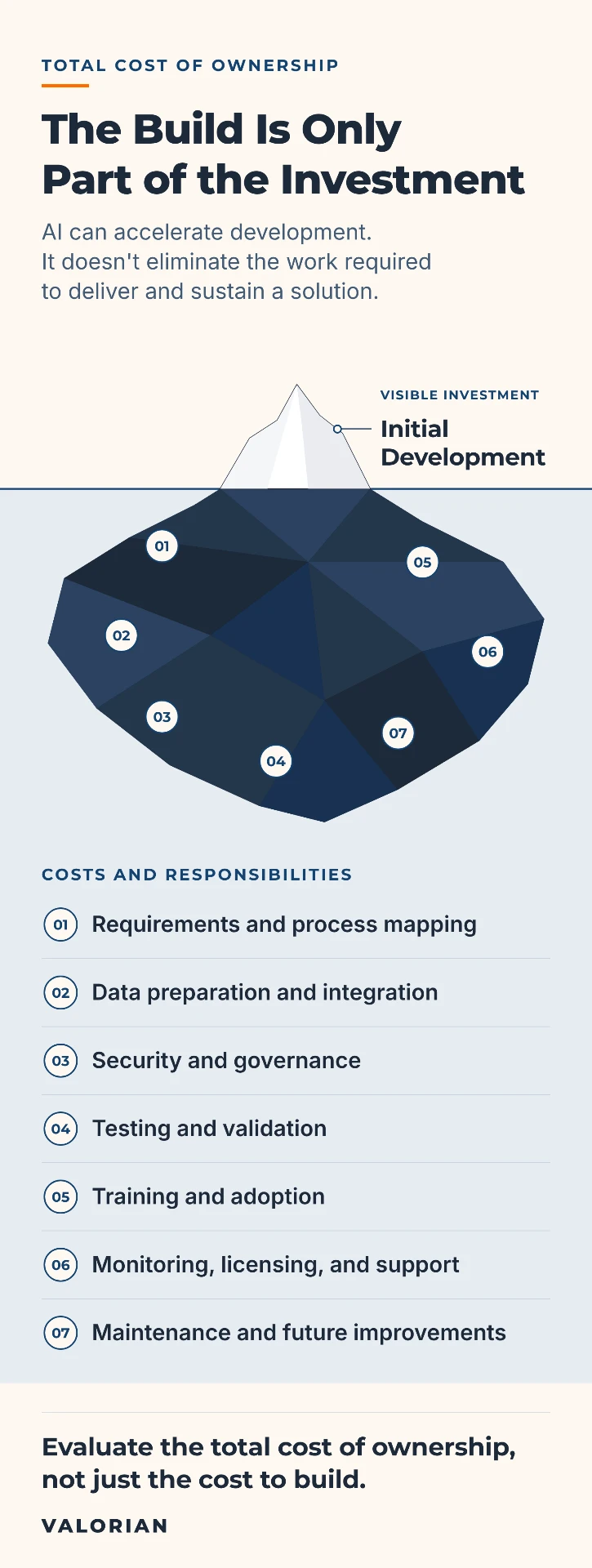
These responsibilities exist whether the technology is developed internally or by an outside provider. The difference is how the work is performed, who is accountable, and what resources the organization must maintain. Internal development may reduce certain vendor expenses while increasing demands on employees and internal technology teams. Partner-developed solutions may introduce implementation and recurring support fees while reducing the amount of specialized development and maintenance work required internally. Neither option is automatically less expensive.
There is also an important cost that frequently gets overlooked: opportunity cost. An organization's IT team may be perfectly capable of building a custom application, but that doesn't necessarily mean it's the best use of their time. For refinery operators, internal technology resources may already be responsible for enterprise systems, cybersecurity, infrastructure reliability, and modernization initiatives. For industrial contractors, those resources may be focused on workforce productivity, project execution, or other business priorities. Redirecting employees toward software development can delay initiatives that may produce greater value for the organization.
Long-term ownership deserves equal attention. An internal application may begin with one capable employee who identifies a problem and builds a useful solution. As more people begin relying on it, additional requirements emerge, new integrations are added, and the application gradually becomes part of everyday operations. If that employee changes roles or leaves the organization, maintaining the system can become difficult without adequate documentation, shared technical knowledge, and a clear support structure. External partnerships also require careful planning around support commitments, intellectual property, data ownership, and the ability to transition to another provider.
A meaningful build-versus-buy analysis should therefore consider the full cost of developing, deploying, operating, and improving the solution over several years. The least expensive application to create isn't necessarily the most economical solution to own.
AI Agents Introduce New Capabilities and Responsibilities
AI agents, sometimes referred to as digital workers, add another dimension to the development decision. Unlike traditional software applications that generally follow predetermined instructions, AI agents can interpret information, evaluate context, interact with connected systems, and perform multiple steps toward a defined objective. For industrial organizations, this creates opportunities to automate processes that previously required employees to investigate discrepancies, retrieve supporting information, coordinate activities, or make routine decisions across multiple systems.
The potential value extends beyond making existing administrative tasks faster. Properly designed digital workers can help organizations reduce manual coordination, identify issues earlier, improve access to operational information, and allow employees to focus on work that requires their experience and judgment. However, giving an agent the ability to interpret information and initiate actions also introduces responsibilities that aren't always present in conventional workflow automation.
An AI agent may reach an incorrect conclusion, misinterpret incomplete information, or take an unexpected action. Its performance can also change when underlying models, instructions, or connected systems are updated. Organizations must therefore determine how the agent's decisions will be evaluated, what information it can access, which actions it can perform independently, and when human authorization is required. These considerations become especially important when an agent interacts with financial records, compliance documentation, or safety-related workflows.
Security and data governance also require careful attention. Industrial organizations must understand where information is stored, how it moves between systems, who can access it, and whether customer or employee data is being shared with external AI providers. Appropriate access controls, monitoring, audit trails, and escalation procedures should be incorporated into the solution from the beginning. Guidance from organizations such as the National Institute of Standards and Technology (NIST) can help companies establish a structured approach to managing AI-related risks.
Importantly, not every process requires an AI agent. Some business problems are better addressed through conventional software, system integrations, or rules-based automation, particularly when the workflow is predictable and doesn't require interpretation or judgment. The objective should be to select the technology that solves the problem most effectively, rather than introducing AI simply because it is available.
When Should Industrial Companies Build, Buy, or Partner?
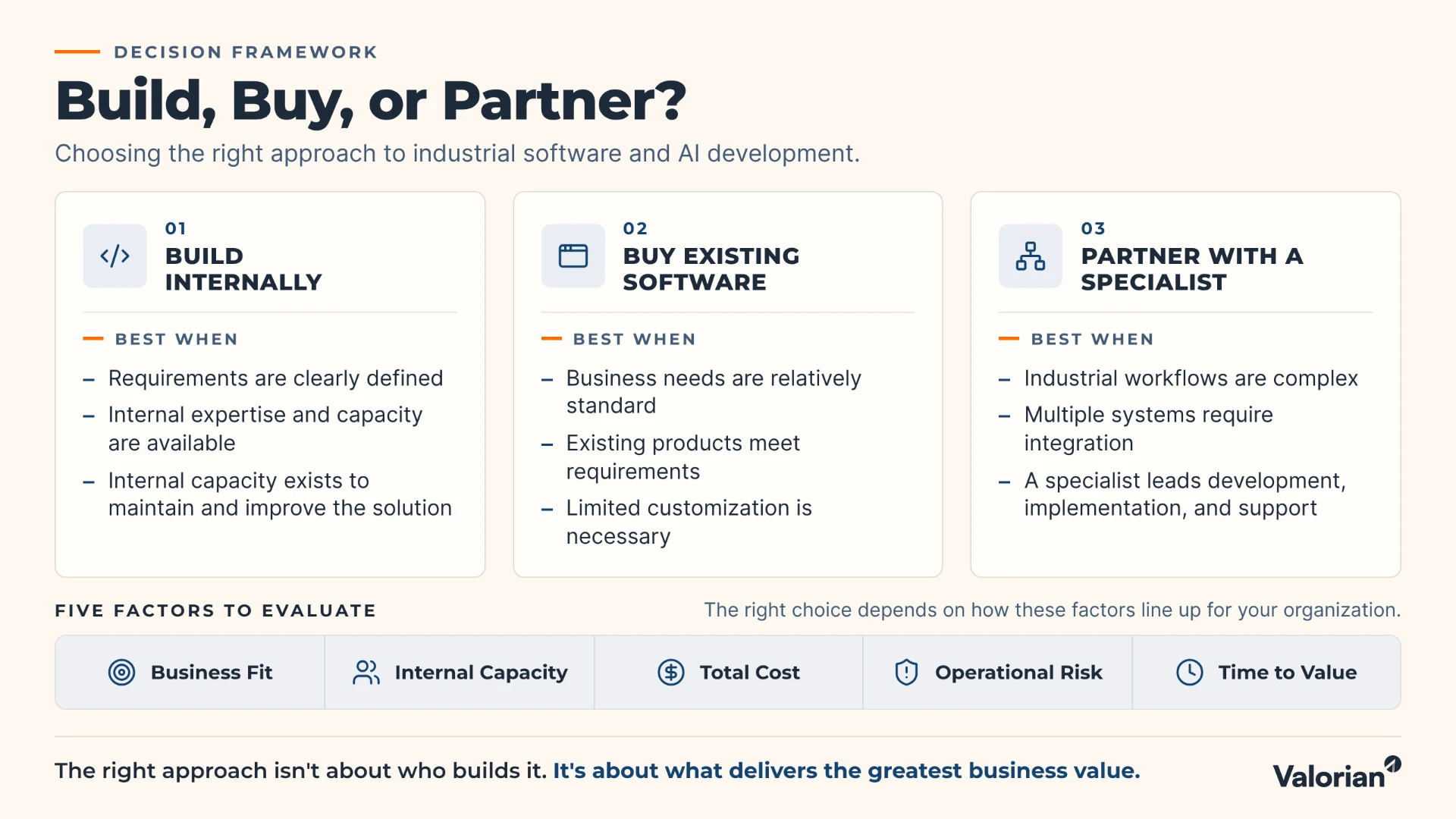
There is no universal answer to the build-versus-buy question. The right approach depends on the complexity of the business problem, the organization's internal capabilities, the desired implementation timeline, and the level of responsibility it is prepared to maintain.
Building internally can be an excellent choice when requirements are clearly defined, the scope is manageable, and the organization has the technical expertise and capacity to support the solution over time. Departmental productivity applications, reporting tools, and narrowly defined automations are often strong candidates for AI-assisted internal development. Organizations with mature software engineering teams may also choose to develop more complex systems when the technology provides a meaningful competitive advantage or represents a strategic capability they intend to own.
Purchasing an established software product may make more sense when the business requirement is relatively standardized and existing solutions already address the majority of the need. This approach can reduce initial development requirements, although companies must still evaluate the product's ability to accommodate their workflows, integrate with existing systems, and support future requirements.
Partnering with a specialized technology provider becomes particularly valuable when the solution involves complex industrial processes, multiple enterprise integrations, significant operational exceptions, or expertise the organization doesn't maintain internally. An experienced partner can contribute industry knowledge, development resources, implementation capabilities, and ongoing support. This may allow internal teams to remain focused on strategic priorities while reducing the burden of delivering and maintaining a complex solution.
Partnering with a specialized technology provider becomes particularly valuable when a solution involves complex industrial processes, multiple enterprise integrations, significant operational exceptions, or expertise the organization doesn't maintain internally. An experienced partner can take responsibility for designing, developing, implementing, and supporting the solution, while working closely with the customer's operational and IT teams to ensure it meets business requirements and fits within the existing technology environment.
Regardless of the approach, the decision should begin with the business problem rather than the technology. Organizations should evaluate total cost of ownership, internal resource availability, implementation timelines, operational risk, and long-term support requirements. The objective isn't to determine which organization is most capable of writing the code. It's to select the approach that delivers the greatest value with the appropriate level of accountability.
Where Valorian Fits
At Valorian, we believe AI is creating an extraordinary opportunity for refinery operators and industrial service providers to rethink how work gets done. Technology that once required significant development investment is becoming more accessible, and organizations can now explore automation opportunities that may have been impractical just a few years ago. But successfully implementing those solutions still depends on understanding the operational processes, systems, people, and challenges involved.
Our approach begins with the business problem. We work to understand how processes operate today, where inefficiencies exist, how information moves between systems, and what improvements would create meaningful value. From there, we determine how custom software, enterprise integrations, workflow automation, or AI-powered digital workers can support those objectives. Sometimes the answer is a conventional application. Sometimes it's an AI agent. Often, it's a combination of technologies working together.
We recognize that many industrial organizations have capable IT teams and are building internal AI expertise. Our role isn't to replace those teams or compete with their broader technology strategies. Valorian takes responsibility for developing and implementing the solutions we deliver, working closely with customer stakeholders to understand operational requirements, coordinate system integrations, and support successful adoption. This approach allows customers to leverage specialized industrial and technical expertise while keeping their internal teams focused on their own strategic priorities.
As AI continues to accelerate software development, we believe the value of a technology partner must extend beyond writing code. It should come from understanding the business, navigating operational complexity, connecting systems and workflows, and helping customers achieve results that justify their investment.
The Real Competitive Advantage Isn't Who Writes the Code
AI is making software development more accessible, and that is a positive development for the industrial sector. More organizations can experiment, more employees can turn ideas into useful tools, and more operational challenges can be addressed without the barriers that once made custom development impractical. But as the ability to create technology becomes more widespread, the distinction between building an application and delivering a dependable business solution becomes increasingly important.
The organizations that benefit most from AI won't necessarily be those that build the most applications or deploy the most digital workers. They'll be the ones that identify the right problems, choose the right approach, and implement solutions that improve how their businesses operate.
AI is changing who can build software. The real competitive advantage will come from knowing what to build, how to make it work, and how to turn that capability into lasting business value.
Frequently Asked Questions
Yes. AI development tools make it increasingly practical for refinery operators and industrial contractors to build internal AI agents, especially for well-defined administrative tasks and processes with limited integration requirements. More complex agents that interact with enterprise systems, manage operational exceptions, or modify business records require additional expertise in integration, security, testing, governance, and ongoing support.
AI can reduce software development time and certain upfront costs, but internal development is not automatically less expensive. Companies must consider the total cost of ownership, including employee time, integrations, infrastructure, security, training, maintenance, and future improvements. A multi-year cost comparison provides a more accurate basis for deciding whether to build internally or work with an external provider.
An outside partner may be valuable when a project involves complex industrial workflows, specialized integrations, limited internal resources, or significant ongoing support requirements. A qualified partner can also complement an existing IT team by providing industry expertise and implementation capacity while allowing the organization to maintain ownership of its technology strategy.